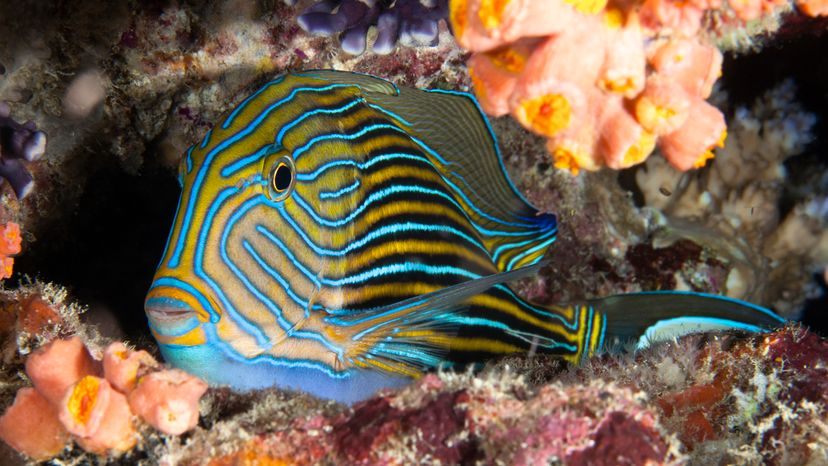
Fish are water-dwelling animals with backbones, fins and two-chambered hearts. While most of us know that fish breathe through gills, there is much more to discover about them. For example, cleaner fish live on the ocean floor and remove parasites from other fish, while flying fish have fins that look like wings, helping them glide above water. Fish come in all sizes, from tiny creatures to very large ones, and they can sleep with their eyes open.
The most common fish in the world is not one we often see. It is called the bristlemouth, a small fish that lives deep in the ocean. Most bristlemouths grow no longer than three inches. To hide from predators, they have light-producing organs on their underside to avoid casting a shadow.
The largest fish is the whale shark, which can reach over 65 feet in length. Despite its large size and strong appearance, the whale shark is gentle and harmless. It feeds on tiny plankton (浮游生物) and small sea creatures by filtering them from the water. Whale sharks can live up to about 70 years unless harmed by humans.
The title of the smallest fish goes to a type of male anglerfish, measuring only about a quarter of an inch. There is some scientific debate about which fish holds this record, but the male anglerfish is currently considered the smallest. The male attaches to a much larger female for life, relying on her for food and movement.
Fish have excellent senses of smell and taste. Some can smell extremely faint chemicals in water — as low as one part per billion. Many have taste buds not only in their mouths but also on their fins and skin. Catfish, for instance, are covered with taste buds from head to tail, including on their whiskers, allowing them to taste food before it even enters their mouth.
Most fish are built to swim forward by moving their tails and cannot easily swim backward. However, some fish like the triggerfish and electric eel can move in reverse by using their fins in special ways. Their ability to swim backwards helps them navigate their underwater world with greater flexibility.
原创编写 版权所有 侵权必究 每日更新 个性化阅读 英语飙升
1.1.What is the purpose of mentioning the flying fish in Paragraph 1?
A To show the diversity of fish.
B To explain the way fish breathe.
C To stress the swimming skills of fish.
D To introduce the sleeping habits of fish.
解析:选A。A推理判断题。作者在第一段提到飞鱼(fins that look like wings, helping them glide)是紧接着“there is much more to discover about them”之后,旨在举例说明鱼类的多样性(diversity),而非解释呼吸方式(B)、强调游泳技巧(C)或介绍睡眠习惯(D)。B、C、D 三项均与飞鱼例子的作用无关。故选A。
2.2.How is the whale shark described in terms of its nature?
A Aggressive and dangerous.
B Shy and amusing.
C Swift and competitive.
D Friendly and mild.
解析:选D。D细节理解题。根据题干关键词“the whale shark”定位至第三段,原文直接描述鲸鲨为“gentle and harmless”(温和且无害)。D项“Friendly and mild”(友好且温顺)是该描述的同义转述。A项(具有攻击性和危险性)、B项(害羞且有趣)、C项(迅速且好斗)均与原文信息矛盾。故选D。
3.3.Which kind of fish has obvious differences in gender roles?
A The bristlemouth.
B The whale shark.
C The anglerfish.
D The cleaner fish.
解析:选C。C细节理解题。根据题干关键词 “gender roles”(性别角色),可定位到原文第四段关于琵琶鱼(anglerfish)的描述:雄性琵琶鱼体型极小(仅四分之一英寸),且 “attaches to a much larger female for life, relying on her for food and movement”(终生附着在体型大得多的雌性身上,依赖雌性获取食物和移动)。这一内容明确体现了该鱼类雌雄在体型、生存方式上的巨大差异。文中提到的其他鱼类(bristlemouth, whale shark, cleaner fish)均未涉及性别角色的描述。故选C。
4.4.What does the underlined part “one part per billion” indicate about some fish?
A They have an amazing sense of smell.
B They can produce special chemicals.
C They are good at hiding from predators.
D They prefer to live in clean water.
解析:选A。A推理判断题。划线部分“one part per billion”出现在第五段首句之后,用于具体说明某些鱼类能嗅到“extremely faint chemicals”的能力。该段主旨是鱼类拥有出色的嗅觉和味觉,此处用具体数据(十亿分之一)是为了强调其嗅觉灵敏度之高。B项(产生特殊化学物质)、C项(躲避捕食者)、D项(偏好洁净水域)均与上下文无关,因此A项正确。