
抛硬币真的随机吗?实验数据给出答案
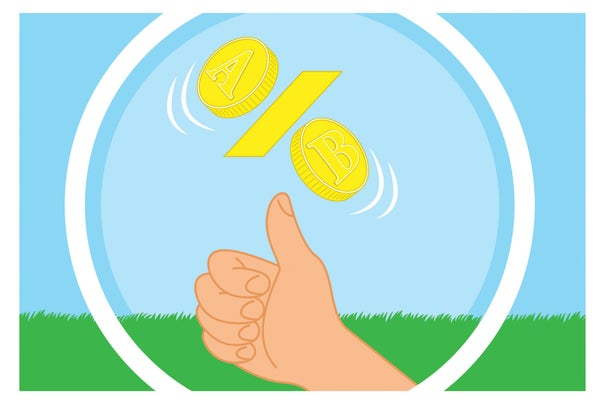
The phrase “coin toss” is a classic synonym for randomness. But since at least the 18th century, mathematicians have suspected that even fair coins tend to land on one side slightly more often than the other. Proving this tiny bias, however, would require hundreds of thousands of precisely recorded coin flips, making laboratory tests a logistical nightmare.
František Bartoš, currently a Ph.D. candidate studying the research methods of psychology at the University of Amsterdam, became intrigued by this challenge four years ago. He couldn’t round up enough volunteers to investigate it at first. But after he began his Ph.D. studies, he tried again, recruiting 47 volunteers (many of them friends and fellow students) from six countries. Multiple weekends of coin flipping later, including one 12-hour marathon session, the team had performed 350,757 tosses, shattering the previous record of 40,000. The flipped coins landed with the same side facing upward as before the toss 50.8 percent of the time. The large number of throws allows statisticians to conclude that the nearly 1 percent bias isn’t a fluke. “We can be quite sure there is a bias in coin flips after this data set,” Bartoš says.
The leading theory explaining the subtle advantage comes from a 2007 physics study by Stanford University statistician Persi Diaconis and his colleagues, whose calculations predicted a same-side bias of 51 percent. From the moment a coin is launched into the air, its entire path — including whether it lands on heads or tails — can be calculated by the laws of mechanics. The researchers determined that coins in the air don’t turn around their center line; instead they tend to shake off-center, which causes them to spend a little more time aloft with their initial “up” side on top.
1.1. Why was it hard to prove the coin flip bias initially?
A The bias was surprisingly large.
B Volunteers refused to join in.
C Enough data was difficult to get.
D No theory could explain it.
解析:选C。C 细节理解题。根据文章第一段最后一句“Proving this tiny bias, however, would require hundreds of thousands of precisely recorded coin flips, making laboratory tests a logistical nightmare.”可知,证明这种微小偏差需要数十万次精确记录的抛掷,这使得实验室测试成为后勤上的难题。因此,困难主要在于难以获得足够的数据,而不是偏差本身的大小(A)、志愿者拒绝参与(B)或缺乏理论解释(D)。选项C准确对应原文细节。故选C。
2.2. What did Bartoš’s experiment with over 350,000 flips prove?
A The earlier record was incorrect.
B Flipping techniques vary widely.
C More throws reduce the bias.
D Coin flips show a small but real bias.
解析:选D。D 细节理解题。根据题干关键信息 “Bartoš’s experiment with over 350,000 flips” 定位到原文第二段:实验得出 “同一面朝上的概率为 50.8%” 的结果,且明确指出the nearly 1 percent bias isn’t a fluke(这近 1% 的偏差并非偶然)、We can be quite sure there is a bias in coin flips(我们可以非常确定抛硬币存在偏差)。原文说实验shattering the previous record(打破了之前的记录),并非证明 “之前的记录错误”,选项 A 错误;全文未提及 “抛硬币技巧存在差异”,选项 B 错误;原文未提到 “更多抛投会减少偏差”,反而强调更多抛投能验证偏差的真实性,选项 C 错误。故选D。
3.3. What is Paragraph 3 mainly about?
A The math model behind the experiment.
B The past tries to explain randomness.
C The physical cause of the coin bias.
D The comparison of different coin types.
解析:选C。 C 段落大意题。第三段核心是介绍2007年的物理学研究,该研究通过力学定律分析硬币在空中的运动路径(path)、非绕中心轴旋转(don’t turn around center line)以及离轴晃动(shake off-center)来解释偏差产生的原因。因此,整段内容围绕硬币抛投偏差的物理成因展开。原文提到的是laws of mechanics(力学定律),并非 “数学模型”;该段只介绍了 2007 年的一个理论,并非 “过去解释随机性的多次尝试”,选项 A 错误;全文未涉及 “不同硬币类型的对比”,选项 D 错误。故选C。
4.4. What is Amelia’s attitude to the new study’s findings?
A Professionally appreciative.
B Cautiously dismissive.
C Publicly skeptical.
D Entirely unconvinced.
解析:选A。A 观点态度题。在最后一段中,统计学家Amelia McNamara虽未参与研究,但她评价该研究“清除了剩余的疑虑”(clear away any remaining doubt),并称其为“基于实验的极好证据”(great evidence based on experiments)。这表现出一种基于专业立场,对研究证据和结论的欣赏与肯定,因此A. Professionally appreciative(从专业角度表示欣赏)最为准确。B. Cautiously dismissive(谨慎地不予理会)、C. Publicly skeptical(公开表示怀疑)和 D. Entirely unconvinced(完全不信服)都与她积极肯定的实际表述相悖。故选A。