
世界最长高速隧道通车,改写跨山出行史!
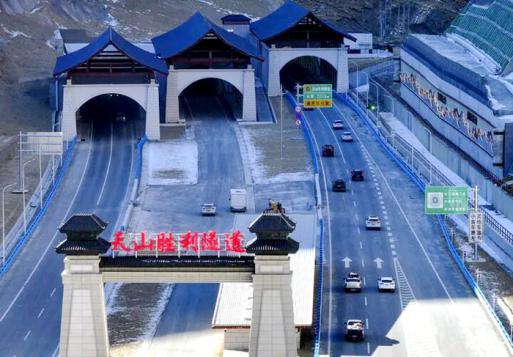
On December 26, 2025, China opened the world’s longest expressway tunnel to the public — the Tianshan Shengli Tunnel. With a length of 22.13 kilometers, this amazing project has changed travel between north and south Xinjiang. Before, the trip took several hours on dangerous, winding mountain roads. Now, it only takes 20 minutes.
The Tianshan Mountains run through central Xinjiang, dividing it into two parts. In the past, crossing these mountains was very hard. Drivers had to take high, narrow roads, and in winter, the roads often closed due to snow and ice, making trips even longer.
Building such a long tunnel was not easy. Workers worked at 3,000 meters above sea level, where winter temperatures drop to -42°C. The area also has frequent earthquakes. Despite these challenges, Chinese engineers finished the project in just five years.
To make the tunnel a success, builders used the newest technologies and smart ideas. Engineer Miao Baodong said they developed new ways to design and build extra-long tunnels. The project cost about 5 billion dollars, which supported the use of advanced technology.
1.1. What is the change for traveling between north and south Xinjiang now?
A It is more dangerous.
B It becomes faster.
C It takes several hours.
D It needs no tunnel.
解析:选B。B 细节理解题。文章第一段明确提到,以前穿越天山需要几小时,现在通过隧道仅需20分钟(“Now, it only takes 20 minutes.”),因此现在的变化是旅行变得更快了。选项A(更危险)和C(需要几小时)与原文相反;选项D(不需要隧道)不符合事实。故选B。
2.2. What made crossing the Tianshan Mountains hard in the past?
A There were no roads at all.
B The mountains were too low.
C The road conditions were poor.
D The weather was always hot.
解析:选C。C 细节理解题。文章第二段指出,过去道路狭窄危险,冬季常因冰雪封闭(“high, narrow roads... often closed due to snow and ice”),这属于路况差。选项A(完全没有路)错误;选项B(山太低)与事实不符;选项D(天气总是炎热)未提及,且文中强调冬季严寒。故选C。
3.3. Which was NOT a difficulty in building the tunnel?
A Freezing temperatures.
B Many earthquakes.
C High altitude work.
D Shortage of money.
解析:选D。D细节理解题。文章第三段列举了建设困难:高海拔(3,000米)、低温(-42°C)和频繁地震,但未提及资金短缺。选项A、B、C均为原文提到的困难,因此D是正确答案。故选D。
4.4. What did Engineer Miao Baodong probably mean?
A New ideas were needed.
B The project was cheap.
C Old methods worked well.
D Machines did most work.
解析:选A。A 推理判断题。工程师苗宝东的话表明,他们为超长隧道开发了新的设计与建造方法(“developed new ways to design and build...”),由此可推断需要新思路和技术。选项B(项目便宜)与原文“耗资约50亿美元”矛盾;选项C(旧方法有效)与“新方法”相反;选项D(机器完成大部分工作)未提及。故选A。
5.5. What does the last paragraph mainly tell us?
A The cost of the tunnel.
B The importance of the tunnel.
C The length of the tunnel.
D The location of the tunnel.
解析:选B。B 推理判断题。最后一段指出隧道不仅是南北疆交通的关键,也展示了中国建筑业的实力,强调了其重要性。选项A(成本)和C(长度)在前文已提到;选项D(位置)不是本段重点。故选B。