
8800朵镜面再生花绽放荷兰设计周
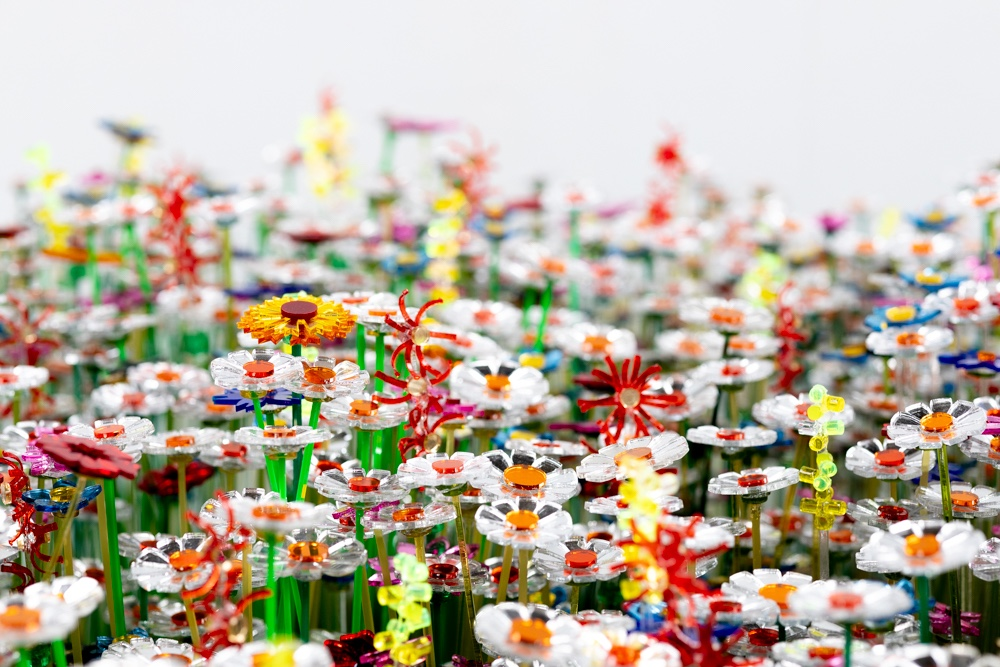
During Dutch Design Week, Ulrike Jurklies and Paul Bas of studio mo man tai presented Reflecting Diverseness, a vibrant installation made up of 8,800 mirrored flowers crafted from upcycled waste materials. Each flower represents one in every 2,000 Dutch residents, coming together to form a colorful portrait of a society that is richly diverse and interconnected.
When coming up with the idea for the installation, mo man tai set out to create a message that felt optimistic and inclusive. By using color and reflection to explore identity, connection, and the beauty of difference, the design duo were able to spark an immediate and powerful response from their audience. “It’s easy to start a conversation with something beautiful and positive,” says Jurklies. “When people are then surprised by the deeper story behind that beauty, a real dialogue begins.”
Mirrored daisies, zinnias, cornflowers, and more were laser-cut from leftover acrylic mirror sheets and assembled by hand. Installed at Pennings Foundation in Eindhoven, the installation is built from 175 numbered boxes, each holding 50 flowers that together form a statistical cross-section of the Dutch population, based on 2024 data from Statistics Netherlands. As light hits each petal at a slightly different angle, ripples of colorful light move across the space, dancing across the walls and floor around it.
The installation quickly became one of the most photographed works of Dutch Design Week, spreading widely across social media. According to the designers, many visitors first discovered the installation on Instagram, then went out of their way to see the stunning field of flowers in person.
Reflecting Diverseness is continuing to bloom beyond its original setting. A section of the installation is currently being reimagined as an XXL bouquet, set to go on display at the FENIX Museum in Rotterdam in early 2026.
1.1.Why did the designers use exactly 8,800 flowers?
A To match the available recycled materials.
B To symbolically represent Dutch population.
C To create a complex visual pattern.
D To follow a traditional art formula.
解析:选B。B细节理解题。文章第一段明确指出:“Each flower represents one in every 2,000 Dutch residents, coming together to form a colorful portrait of a society...” 并且第三段提到装置基于2024年荷兰统计数据(Statistics Netherlands)构建。虽然文章未直接说明8,800的具体计算方式,但通过“每朵花代表每2000名居民”这一细节,可以推断花朵总数与荷兰人口统计相关(例如,8800朵花象征约1760万人口,符合荷兰人口规模)。因此,设计者使用8800朵花是为了象征性地代表荷兰人口结构,而非出于材料匹配(A)、视觉图案(C)或传统公式(D)。故选B。
2.2.Where did the designers most likely draw their core inspiration from?
A Purely aesthetic experiments.
B Classical art traditions.
C Social diversity and inclusion.
D Natural flower forms.
解析:选C。C推理判断题。文章并未直接说明灵感来源,但通过多处描述可推断核心灵感源于社会多样性与包容性。第一段强调装置呈现“a society that is richly diverse and interconnected”;第二段指出设计目的是传递“optimistic and inclusive”的信息,并探索“identity, connection, and the beauty of difference”。虽然装置使用了花朵形态(D),但这只是表现形式;设计重点并非纯粹美学实验(A)或古典艺术传统(B),而是通过艺术引发对社会议题的思考。因此,核心灵感来自社会多样性与包容性。故选C。
3.3.What is the main focus of Paragraph 3?
A Social media influence.
B Production and visual effect.
C Future exhibition plans.
D Public voting procedures.
解析:选B。B段落大意题。第三段主要描述了装置的制作过程与视觉效果:具体说明花朵由“laser-cut from leftover acrylic mirror sheets and assembled by hand”,安装方式基于统计数据,并详细描写光线照射时“ripples of colorful light move across the space”的视觉效果。该段落未涉及社交媒体影响(A,在第四段)、未来展览计划(C,在第五段)或公众投票程序(D,未提及)。因此,本段核心焦点是制作细节与视觉效应。故选B。
4.4.What dual effect does the installation achieve?
A Visual appeal and public popularity.
B Static display and online silence.
C Temporary existence and quick removal.
D High cost and limited access.
解析:选A。A推理判断题。文章通过多处信息推断装置兼具视觉吸引力与公众流行度。第二段提到设计使用“color and reflection”创造“beautiful and positive”体验;第三段描述光线产生“colorful light”的迷人效果,体现视觉魅力。同时,第四段指出装置成为“most photographed works”,在社交媒体广泛传播,吸引游客亲自参观,体现公众流行度。选项B(静态展示与在线沉默)与文章描述的活跃传播相反;选项C(临时存在与快速移除)错误,因第五段提到装置部分将在博物馆重新展示;选项D(高成本与有限访问)文章未提及。因此,装置实现了视觉吸引力与公众流行度的双重效果。故选A。