
灯塔水母的 “生命重启” 密码
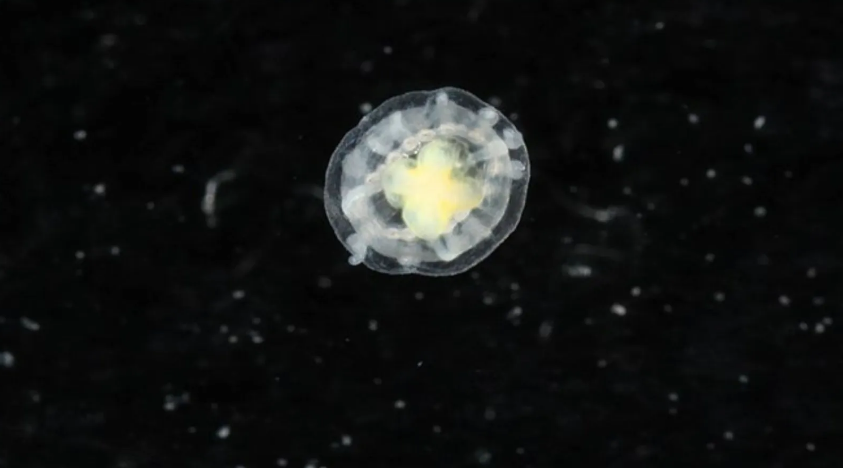
One ocean-dwelling creature found in tropical waters is known to be able to reverse its own life cycle, cheating death. The jellyfish, Turritopsis dohrnii, was first discovered in 1883, but it was around 100 years later that scientists uncovered the creature’s ability to rejuvenate its own life cycle and combat environmental and physical stresses.
The T. dohrnii’s ability to rejuvenate could “hold important clues to maintaining a long life and lengthening the healthspan of humankind,” Michael Layden, a professor of biological sciences at Lehigh University, said. He added that the jellyfish were also “very inexpensive to work with in a lab, and thus have the potential to be a huge return on investment for biomedical research. It likely opens up novel strategies to develop therapies to treat damaged tissues and organs.”
T. dohrnii is around 4.5 millimeters wide and tall, making it smaller than the nail of your little finger, and when it experiences environmental or physical stresses, which could include starvation, instead of dying, it rejuvenates itself.
Essentially, its cells can “transform into new cell types turning the unhealthy or stressed adult medusa into a ball of tissue from which a polyp can grow,” professor Christine Schnitzler said. A medusa is the term used to describe an adult jellyfish and a polyp is the name for the organism at its early stage of life. This process — the medusa turning into a new polyp, which is referred to as transdifferentiation — also reportedly takes only 24 to 36 hours.
In order to carry out this process, when T. dohrnii is “physically damaged, starving, or stressed by temperature changes,” it sinks to the ocean floor to begin the transformation, “effectively bypassing death,” Maria Pia Miglietta, a professor of marine biology at Texas A&M University, said.
1.1.What can be inferred about lab studies on T. dohrnii?
A Costly but effective.
B Needs advanced tools.
C High research value.
D Focuses on marine ecology.
解析:选C。C推理判断题。文章第二段提到,教授 Michael Layden 指出这种水母“实验室研究成本低廉”(very inexpensive to work with in a lab),并具有“巨大的投资回报潜力”(huge return on investment for biomedical research),且可能“为开发疗法开辟新策略”。由此可推断,该研究具有很高的科学价值。A 项“昂贵但有效”与“成本低廉”矛盾;B 项“需要先进工具”未提及;D 项“聚焦海洋生态”偏离重点(文章主要探讨其生物医学价值)。因此正确答案为 C。
2.2.Which statement about T. dohrnii is correct?
A It was discovered in the 1980s.
B It reverses life only when starving.
C It lives in deep cold waters.
D It is smaller than a little fingernail.
解析:选D。D细节理解题。文章第三段首句明确指出:“T. dohrnii is around 4.5 millimeters wide and tall, making it smaller than the nail of your little finger”,即其体型小于小指甲。A 项“在 1980 年代被发现”错误(首次发现是 1883 年);B 项“仅在饥饿时逆转生命”不准确,文中提到环境或物理压力(包括饥饿、温度变化等)均可触发;C 项“生活在寒冷深水”错误,第一段说明它生活在热带水域(tropical waters)。因此 D 项正确。
3.3.What does the underlined word “transdifferentiation” refer to in the text?
A Jellyfish grow larger quickly.
B Cells change into new types.
C Genes repair themselves.
D Polyps become medusas.
解析:选B。B词意指代题。“transdifferentiation”出现在第四段,其前一句已解释:“its cells can ‘transform into new cell types’”(它的细胞能转化为新的细胞类型),后一句进一步说明这是“medusa turning into a new polyp”(成年水母变为新生幼体)。因此该词指细胞类型转变的过程。A 项“水母快速变大”未提及;C 项“基因自我修复”只是相关机制的一部分;D 项“幼体变为成年水母”与原文描述方向相反。故 B 项正确。
4.4.What is the main idea of the passage?
A A jellyfish’s unique ability.
B Benefits of marine research.
C Human longevity secrets.
D Cell transformation process.
解析:选A。A主旨大意题。全文围绕 Turritopsis dohrnii 水母能够逆转生命周期、返老还童的独特能力展开,并探讨其科学意义。B 项“海洋研究的好处”过于宽泛;C 项“人类长寿秘密”只是潜在应用,非核心主题;D 项“细胞转化过程”只是该能力的一部分机制。A 项“一种水母的独特能力”精准概括了文章核心主旨,因此正确。故选A。